
The Worst Call I Ever Made
In 2013, I was doing weekly Q&As on Twitter. Someone asked me about Bitcoin.
It was trading at $60.
I said: “bitcoin is a fad, or a scam, or a ponzi scheme, or worse.”
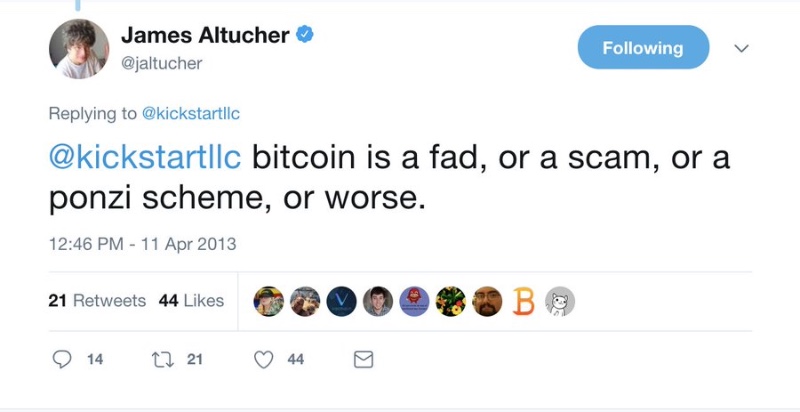
Then my friend Naval Ravikant flew to New York, stood at a whiteboard for an entire day, and showed me why I was wrong.
By the end I realized Bitcoin might be the most amazing thing I'd ever seen in finance—and I'd been in finance since 1999.
Three months after calling it a scam, I released my book Choose Yourself on a Bitcoin-only store I built myself.
I sold about 60 copies for a tenth of a Bitcoin each. Six dollars at the time. That tenth of a Bitcoin is worth about $7,000 today.
So, in a way, I sold 60 copies for $7,000 each.
I got reminded of all this last week in Paris.
I was at the Proof of Talk conference when an interviewer named Anna Tutova asked the one question I never escape:
"Didn't you call Bitcoin a scam?"
Here’s the lesson I learned back then:
When something sounds insane, that's exactly when you should sit down with the smartest person you know and let them draw on a whiteboard.
In fact, that’s exactly why I went to Paris in the first place.
I wanted to talk to some of the smartest people in the world about the most insane idea in AI.
Why I'm All-In on Decentralized AI
Here's what else I told Anna in Paris: centralized wins the sprint. Decentralized wins the war.
Anthropic just raised $65 billion. OpenAI will raise $100 billion.
But what happens when the models keep getting bigger? You can't raise a trillion dollars. At some point the math breaks.
Decentralized networks don't have that problem. People all over the world contribute. The network compounds while the centralized players hit walls.
This is how the internet evolved.
Thirty years ago everyone ran Windows or Mac. Meanwhile, thousands of strangers were quietly building Linux. Today Linux sits at the core of nearly everything. The decentralized operating system won.
Same with news. CBS, CNN, Fox—centralized, run by a few people telling you what matters. Then the internet turned everyone into a news source.
AI is next. And the leader in decentralized AI, by far, is Bittensor—TAO.
TAO trades around $300. I said on camera: $3,000 by year-end. Long term, $50,000 to $100,000.
A handful of the 128 subnets are already the best in the world at what they do, and the only way to invest in subnets is through TAO.
And Then I Made Everyone Mad
The interviewer asked about quantum computing cracking crypto.
Here was my answer: Quantum computing is science fiction.
It doesn't exist in any way that solves a real-world problem. I went to graduate school for computers. I work with quantum companies. Google solved a complicated math problem—good for them.
That's a demo, and a demo won't hack Bitcoin.
Maybe in a hundred years. Maybe I'm the guy calling Bitcoin a scam at $60 again.
But I doubt it. Because this time I've already been to the whiteboard.
I've made three famous calls now: the one I got wrong, the one I'm all in on, and the one nobody wants to hear.
Clip this email and grade me in a year.


